
CMS
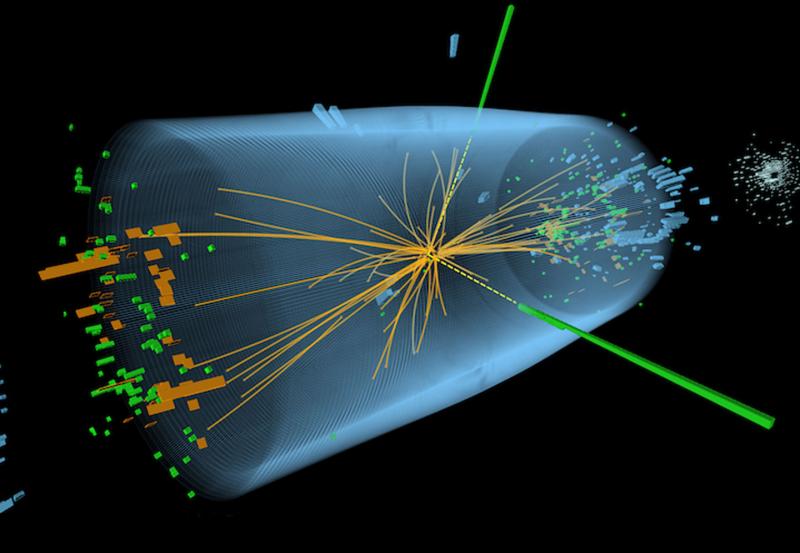 The CMS experiment is located inside the Large Hadron Collider (LHC) at CERN in Geneva, Switzerland. The two main goals of the experiment are to understand the origin of electroweak symmetry breaking and to search for physics beyond the standard model. The Higgs boson discovery announcement on July 4, 2012 was a great leap forward in meeting the first goal and completes the discovery of the standard model particles. In the search for new physics, we have ruled out many possibilities and continue to search for what lies beyond. The CU CMS group has four current faculty members: John Cumalat, Kevin Stenson, Keith Ulmer, and Steve Wagner as well as an emeritus faculty member: Bill Ford. Cumalat’s research focus is on searches for Z′ decays to τ pairs and rare decays of Z bosons. Ford, Stenson, and Ulmer are working together on searches for supersymmetry in hadronic modes. Stenson and Ulmer are also performing research on upgrades to the CMS trigger system, incorporating track reconstruction at the first level. Wagner’s research focus is on R&D of silicon sensors and electronics for the upgraded CMS pixel detector. Colorado also hosts a Tier-3 CMS computing site.
Delivery Address:
Department of Physics
Duane Physics E1B32
2000 Colorado Ave
Boulder, CO 80309-0390
Mailing Address:
Department of Physics
390 UCB
University of Colorado
Boulder, CO 80309-0390
Phone: (303) 492-1228
Fax: (303) 492-5119
Directions and Parking
About us
University of Colorado Boulder
© Regents of the University of Colorado
Privacy
Legal & Trademarks